
LRD Thermal Overload Relay
LRD13 and LRD33 thermal overload relays with adjustable current settings and auxiliary contacts.
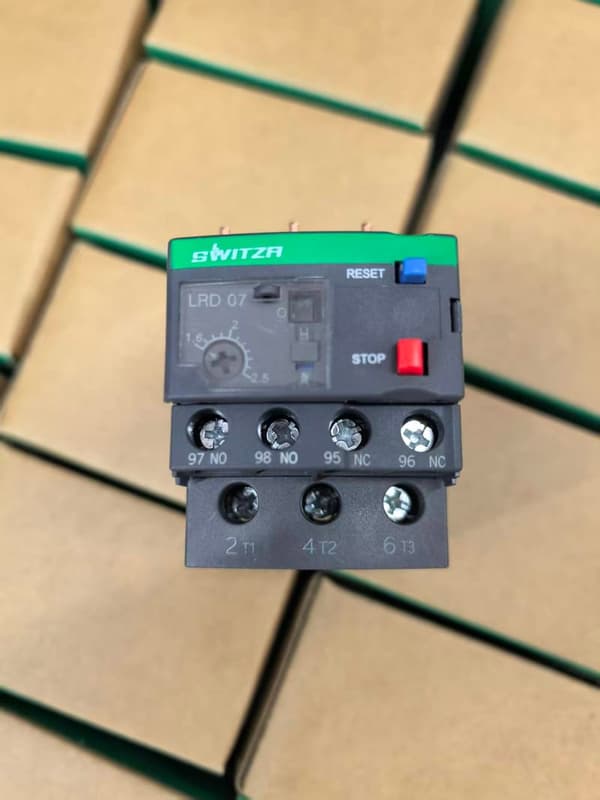
LRD Thermal Overload Relay
LRD13 and LRD33 thermal overload relays with adjustable current settings and auxiliary contacts.
| Specification | Details |
|---|---|
| LRD13 Range (Small) | 1.6-2.5A to 24-32A |
| LRD33 Range (Big) | 32-40A to 80-110A |
| Frequency | 50/60 Hz |
| Features | Adjustable Current Setting & Auxiliary Contact |
Product Overview & Technology
Relays are electrical switches that open and close circuits electromechanically or electronically. Switza offers premium Thermal Overload Relays (LRD series) and Solid-State Relays (SSR) designed to protect industrial motors and control heating elements with extreme accuracy and reliability.
Key Features & Benefits
- check_circleSolid-state options (SSR) offer near-infinite switching lifespans with zero contact wear.
- check_circleThermal overload relays feature adjustable current setting ranges for precise motor protection.
- check_circleBuilt-in phase failure protection and ambient temperature compensation on LRD series.
- check_circleHigh insulation voltage and low power consumption for efficient control panel wiring.
Industrial Applications
- settingsElectric motor overload protection in starters and MCC panels.
- settingsHigh-precision temperature control loops in ovens, extruders, and heaters.
- settingsSignal multiplication and electrical isolation in PLC outputs.
- settingsPneumatic and hydraulic solenoid valve control panels.
Frequently Asked Questions
A thermal overload relay monitors motor current and uses bimetallic strips that bend when heated by excessive current. If the current exceeds the set threshold for a safe duration, the relay trips, cutting off power to the contactor coil and protecting the motor from burning out.
SSRs have no moving parts, offering near-infinite lifespans, zero acoustic noise, faster switching speeds, and resistance to vibration and harsh environments, making them ideal for high-duty temperature control loops.
Yes. SSRs generate heat during operation due to the internal semiconductor voltage drop. For load currents exceeding 10A, mounting the SSR on a properly rated heat sink is essential to prevent thermal failure.
Ready to power your operations?
Get in touch with Switza to power your panel building and manufacturing requirements.